The terminal coding agent that finishes the job.
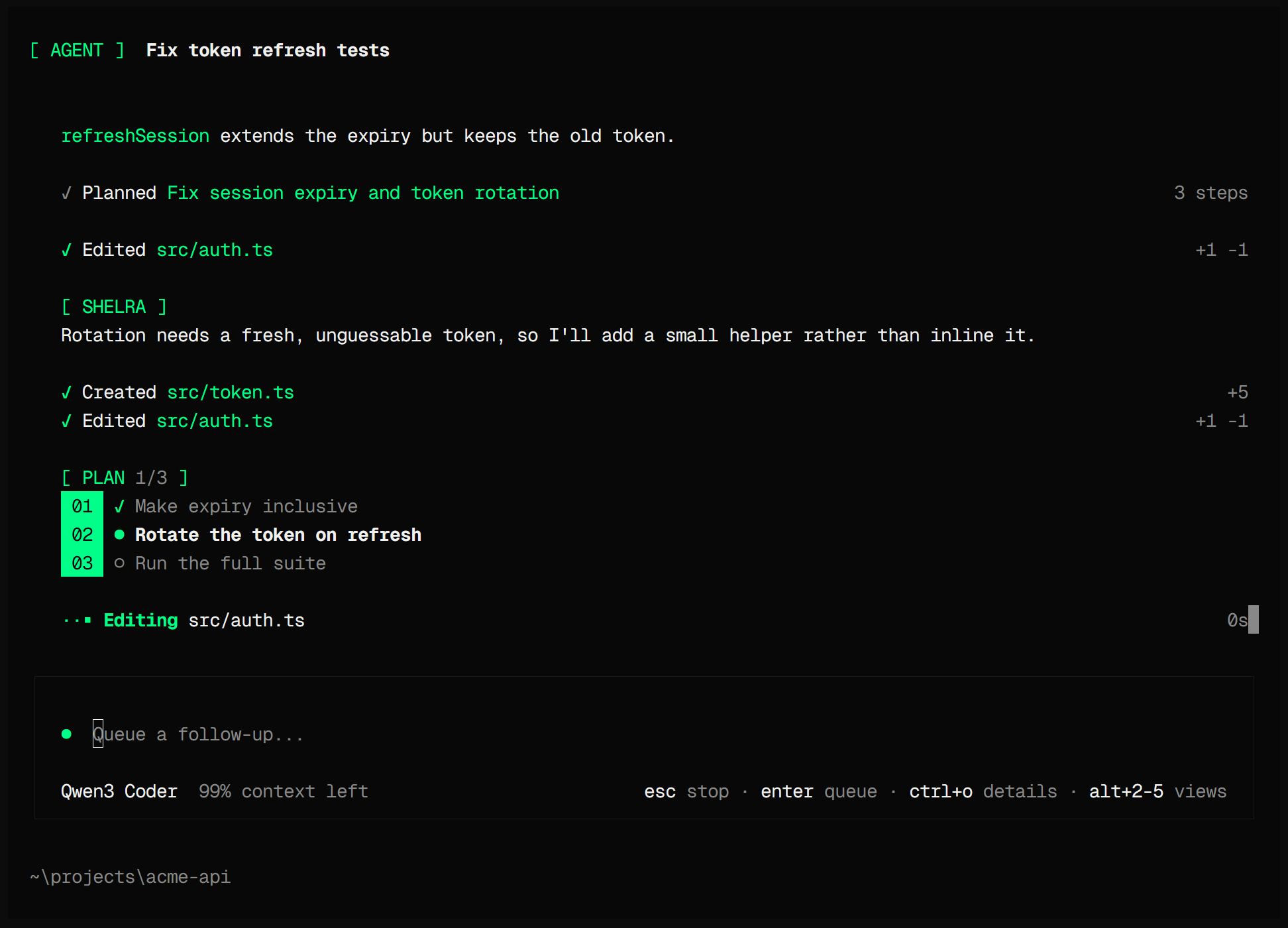
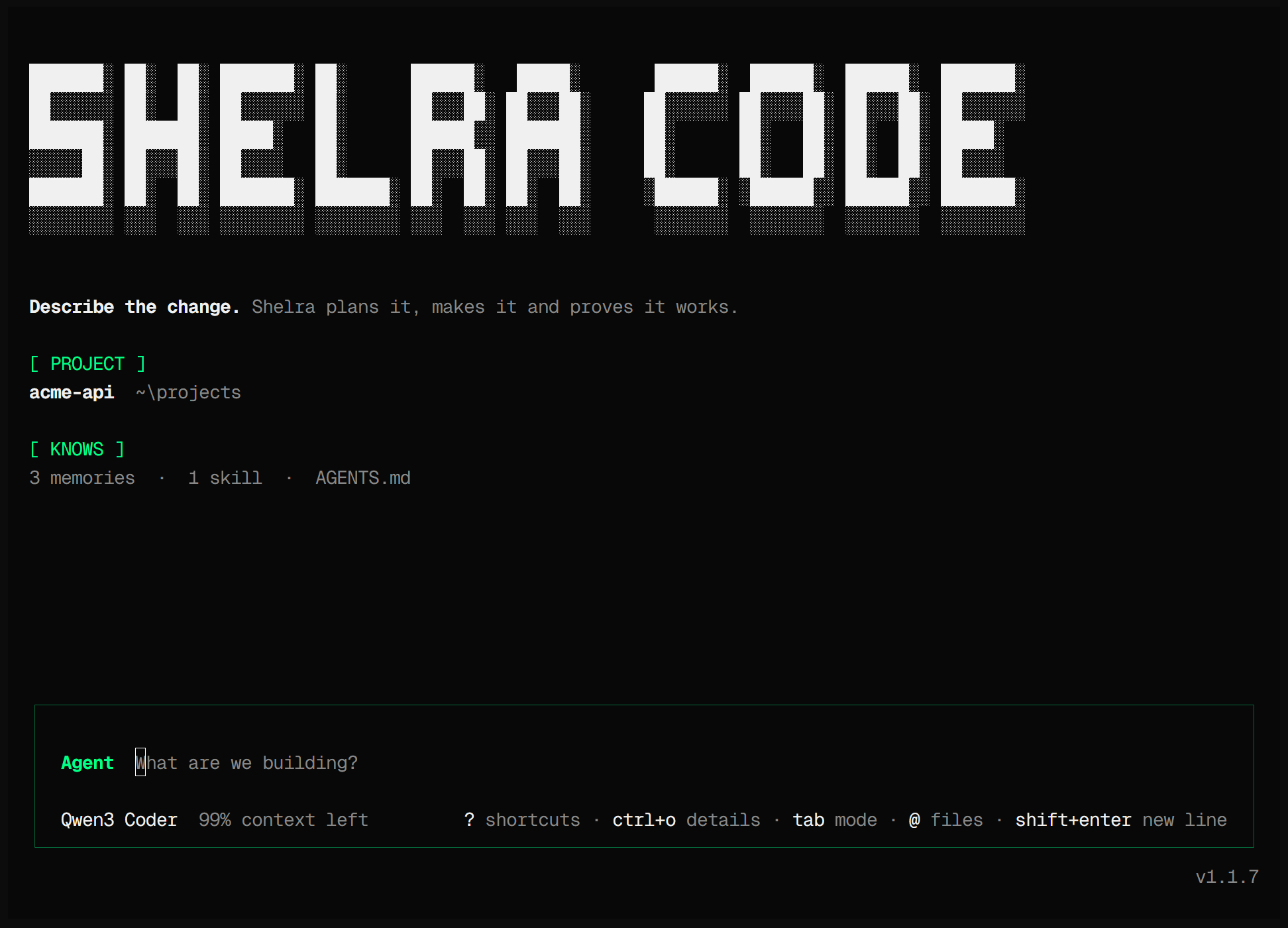
Type the task. ShelraCode reads your repo, plans, edits, runs the tests and verifies the result — on OpenRouter Free by default, on your own key when you allow it, fully local when you say so.

[
BENCHMARK
]
Measured, not promised. Same tasks, same oracle, every run on record.
[
CORE SUITE
]
shelra-agent-core v0.2.0 · 8 tasks
updated 2026-09-23 · 32 runs on record
Agent · model
Resolved
Cost
Time
Run
ShelraCode
deepseek/
5/8
$0.03
15 min
#22 · 2026-09-17 · 572c0e0
ShelraCode
qwen/
5/8
$1.32
27 min
#11 · 2026-09-17 · af7e7bd
Claude Code
Sonnet 5
being recorded · audit 2026-09-23
Codex
gpt-5.6-luna
being recorded · audit 2026-09-23
[
HARNESS PROGRESS
]
qwen/qwen3-coder-30b-a3b-instruct
Same model and tasks; only the harness changed between runs. · * tasks lost to the provider, not to the harness
[
FIELD CASE 001
]
2026-09-22
Google Meet says the camera is in use by another app
ShelraCode · free model
Solved · 1 try
Claude Sonnet 5
3 tries
Re-runs on later commits: 7 min → 5.3 min → 3.1 min · 29 → 22 → 14 tool calls
One run is one sample · benchmark-owned oracle · model pinned per run · cost as billed by the provider · full record in bench/history
See every run
[
FEATURES
]
Free models first. A harness that makes them finish.
0.1
Cloud-first, free first
$ shelra
"fix the flaky token refresh"
> Policy free · openrouter
> Editing src/auth.ts
step 4 of 6
80%
> Running bun test_
OpenRouter Free by default
The live catalog is discovered and filtered by capability. The free policy routes to models that can do the job and never picks a paid one silently; your key and your caps decide the rest.
0.2
Persistent memory
.shelra/memory/
├── index.md
├── topics/auth.md recalled
└── history.jsonl
.agents/skills/
└── release-notes/SKILL.md
3 memories · 1 skill · AGENTS.md
It remembers your project
Facts about the codebase live in .shelra/memory and are retrieved for every request. After a verified change, one bounded reflection proposes what to keep and a deterministic gate decides.
0.3
Verified, or it says so
verify
PASS
bun test · 5 pass · 2.0s
2 files · +9 −2
AC1 · expiry is exact
AC2 · token rotates
AC3 · no regressions
No “done” without a real check
A turn that changed files but ran no test, build or request against the running app is asked to verify before it may finish, and is marked Not verified if it never does.
[
USE CASES
]
Every task a senior dev would dread. ShelraCode runs it.
Fix a bug
Build a feature
Verify an app
Find it. Fix it. Prove it.
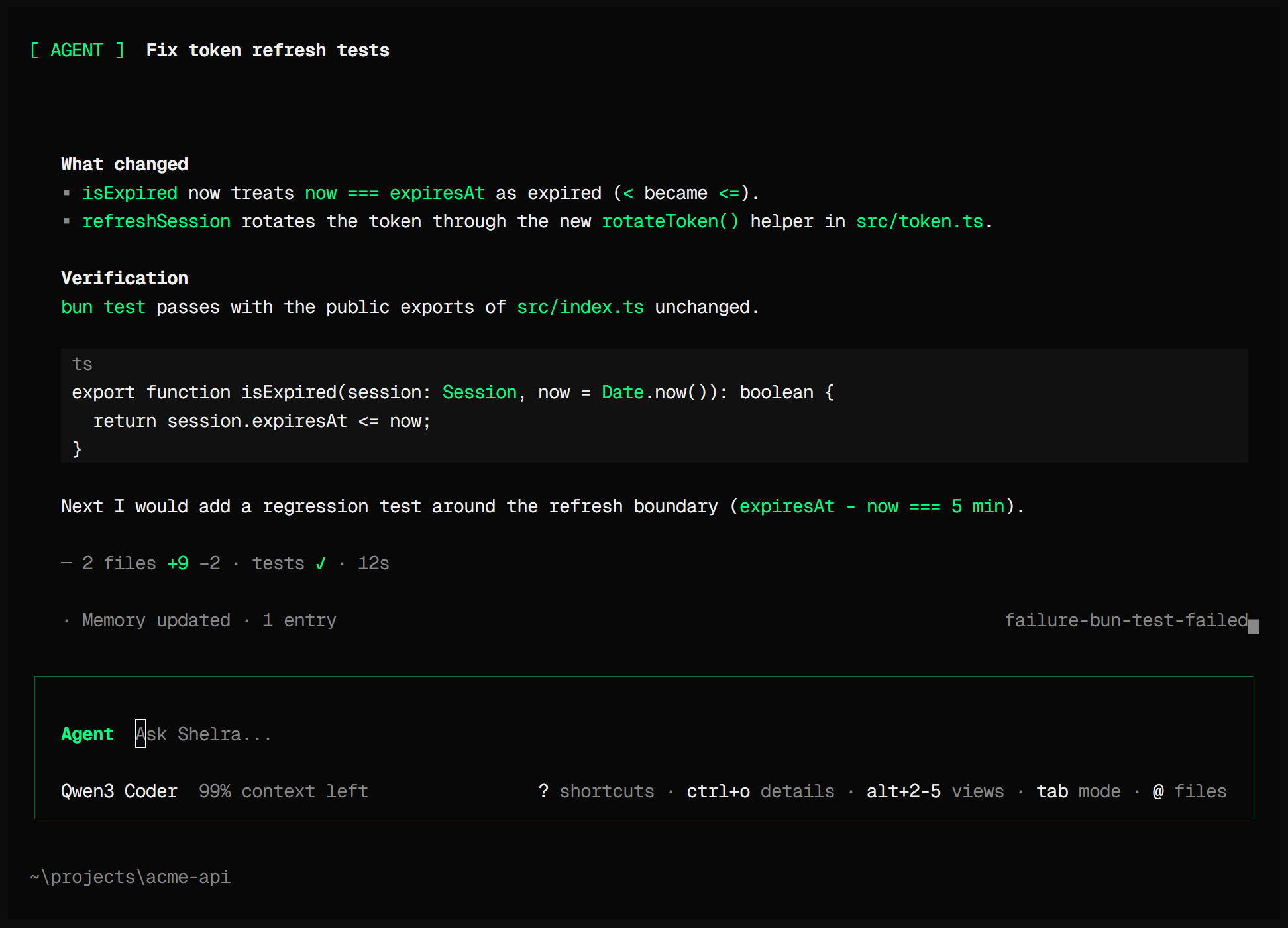
Describe the bug in plain English. ShelraCode locates the cause across the repo, patches it, runs the suite and keeps going until it is green — retrying the round, and moving to a fallback model, if the provider stalls.
Root cause found across the whole codebase
Regression test written and run
Provider trouble never ends the turn
Get started
[
HOW IT WORKS
]
Three steps. Then get out of the way.
1
Say what you want
In the terminal: shelra fix the flaky test in src/foo.test.ts. Or type in the composer, message it from your phone through Telegram, or run it headless with -p for scripts and CI.
2
ShelraCode plans, edits, runs
It reads the codebase, publishes a plan for anything non-trivial, edits, runs the tests and iterates. Sub-agents explore, plan and verify alongside it.
3
Review what was verified
The summary says what changed and which checks ran. Open /diff and /checks, resume with --session latest, and memory carries what it learned into the next task.
[
BENEFITS
]
Less overhead. More output. Free first.
Free first
The default policy routes to OpenRouter Free models. Paid routing only inside a policy and a spend cap you set, checked before each request is sent.
Never aborts
A rate limit, a cut stream or a rejected key keeps the finished steps, retries, then falls back: another key, OpenRouter Free, an installed local model. Only Esc ends a turn.
Sub-agents
explore, plan, general, vision, verify and computer, plus background delegation and your own named agents in user settings.
On the record
Sessions in a local SQLite database, --session latest to resume, hooks on every tool, and autonomous plans with their evidence under .shelra/objectives.
Your tools
AGENTS.md instructions, Agent Skills, MCP servers, lifecycle hooks and a Telegram bridge. No new workflow to learn.
Private when needed
--local runs a managed llama.cpp engine with a SHA-verified GGUF on loopback. Keys live in ~/.shelra/auth.json; a Shuru microVM sandbox is available on Apple Silicon.
[
FIELD NOTES
]
Real problems. What happened when they met free models.
[
PRICING
]
Free first. Your key or your machine when you want.
Free
$0
/forever
OpenRouter Free models with the whole harness. No card, no trial: an OpenRouter key is all it takes.
Install
Included
Live OpenRouter Free catalog
Memory, sub-agents, web research
Skills, MCP servers, hooks
Telegram remote control
Your key
BYOK
$0
$0
/session cap
Point it at OpenRouter or any OpenAI-compatible provider. The cap runs before every request; a paid model is never picked silently.
Read the docs
Included
Routing policy: free → max
--max-cost and --max-request-cost
shelra models use <id> to pin one
Falls back to Free on a bad key
Local
$0
Private or offline: a managed llama.cpp engine with a SHA-verified GGUF, chosen for your hardware, health-checked before chat.
Run --local
Included
No API key, nothing leaves the box
Resumable, verified GGUF download
Picks the model for your hardware
Same agent loop, tools and memory
[
FAQ
]
Before you install. Everything you need to know.
Do I need an API key?
Which models does it use?
Does my code leave my machine?
What happens when a provider fails mid-task?
How does it remember my project?
Can I run it without the TUI?
Your backlog won't clear itself.
Give ShelraCode the task. Get it back verified.
Runs with the tools you already have